
Last Updated on June 13, 2026 by Mr.Feng
This article is part of Experiment #001. Iteration 2 passed the compliance test, but had zero conversions. That forced me to confront a harder question: not how to run ads, but what kind of offer actually works with Google search cold traffic. This article is where I shifted from optimization thinking to offer selection thinking.
Background
After my Iteration 2 experiment, I had confirmed how to create a compliant landing page and set up Google search campaigns. But I quickly realized that knowing how to run ads is only half the battle, choosing the best affiliate offers for cold traffic is just as critical, if not more so.
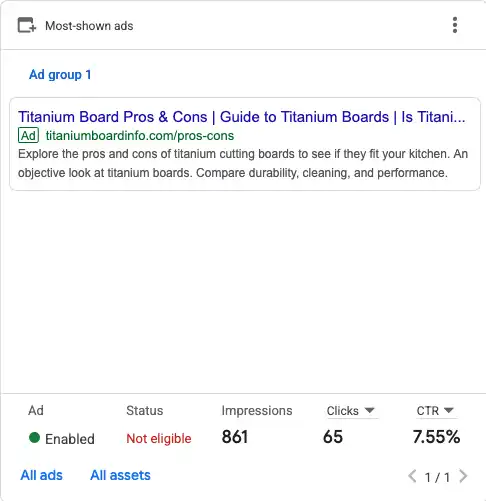
After running the campaign for 14 days, I manually paused it. I noticed that the CTR was actually not low, 7.55%. This showed that the keyword selection and ad copy were generally fine. However, there were no conversions. At first, I thought the problem was with the landing page, maybe the copy wasn’t persuasive enough to match the search intent behind the keywords. But after digging deeper, I realized that the main problem actually lies with the product itself. It’s an e-commerce product with relatively high friction. Running this offer with cold Google search traffic, even if I kept testing, would probably just burn more money with almost no chance of converting.
Why This Offer Failed on Cold Search Traffic
After this experiment, I realized something important. Google search traffic is hot in intent but cold in trust.
Users on Google are actively looking for solutions. From the perspective of search intent, this is high-intent traffic.
But they don’t know me.
They don’t know my website.
They don’t know the brand behind the offer.
There is no prior relationship, no brand recognition, and no trust.
That is what makes it cold.
The offer I tested was a relatively high-priced ecommerce product. It required users to make a purchase decision on their first visit, and I didn’t have a multi-step funnel in place. This made it extremely difficult.
Why Most Ecommerce Affiliate Offers Struggle with Google Search Ads
During Iteration 2, I tested several physical ecommerce offers from affiliate networks. What I found was that most of these products were generic items with inflated pricing. For example, on networks like ClickDealer, many of the products could easily be found on Amazon, Temu, or AliExpress at much lower prices. In some cases, the brand names were exactly the same.
In a market where price transparency is almost complete, this creates a serious conversion challenge. Users can compare prices within seconds. If they can find the same product cheaper elsewhere, it becomes very difficult to close the sale.
The only way this model might work is if you identify a very strong commercial-intent angle and build a landing page that aligns perfectly with that intent. But from my experience, that is not easy. Especially when running Google Ads search campaigns with cold traffic, it is hard to build trust in a direct arbitrage setup.
There may be unique branded products or differentiated offers inside some networks. However, as a beginner, I have not found many of them. Even if I did, getting approved to promote those offers could be difficult.
There are also affiliates like Amazon. While they are easy to trust and convert well, the average commission is only 4%. For Google search ads, this makes it very difficult to cover the costs.
From Optimization to Offer Selection
Once I realized that the core problem was the offer itself, I started rethinking a more fundamental question. If I kept testing this offer, I would likely spend all my time optimizing the ad copy, the landing page copy, and the campaign settings. But if the offer itself didn’t fit cold search traffic, it would not give me meaningful feedback in a short period of time. All that optimization would only increase losses.
This experiment made me realize that I needed to redefine what kind of offer truly works for Google Ads cold search traffic.
How to Select the Best Affiliate Offers for Cold Traffic: My 5 Criteria
To select the right affiliate offers for Google cold traffic in my upcoming Iteration 3 experiment, I established the following 5 criteria for selecting offers.
1. High LTV
In my previous experiments, I found that the conversion rates for Google Ads search campaigns were generally low, and most keywords had relatively high CPCs, especially for campaigns targeting the US market. If the LTV is too low, it is hard to turn a profit. High LTV means that the revenue from each conversion is enough to cover ad costs, so even with high CPCs, there is still room for profitability.
To determine whether an offer has high LTV, I estimate the revenue from each conversion and the long-term value of the user to make sure the ad budget can support a positive ROI.
2. High Commercial Intent
When screening offers, the first thing I look for is whether the offer has a clear payment path. It must have transparent pricing and allow users to purchase or sign up directly. This is what I consider high commercial intent from the offer side.
Next, when users search on Google using high commercial intent keywords related to the offer, those keywords reflect a clear intention to buy or register. These users are actively trying to solve an urgent problem or fulfill a specific need. Compared to informational searches, this type of traffic is far more likely to take action.
Therefore, I focus on selecting offers that align with high commercial intent keywords, making sure that visitors who land on my page already have a strong motivation to convert.
3. Low Friction Conversion
Cold traffic users do not know me. If the first visit to the landing page requires them to make a high-priced purchase, enter credit card details, or fill out a complicated form, it is almost impossible to convert.
I prioritize low-friction offers, such as free trials, simple sign-ups, or low-cost purchases, so that users can complete the desired action on their first visit.
4. Google Compliance
Before anything else, the single most important thing is to confirm whether they actually allow Google Ads. Don’t try to promote offers that are sensitive in terms of Google compliance. Like I mentioned in my article “10 Points to Get Your Affiliate Landing Page Approved on Google Ads in 2026,” as a beginner I just stay away from them. Things like finance, insurance, or gambling affiliate offers might pay really well, but they’re tough to get approved under Google’s rules.
5. Low-Cost, High-Intent Keywords
For my low-budget tests, I need to spend the least money to collect the most feedback signals. Keywords not only need high commercial intent, but I also have to look for ones where the high range bid isn’t too expensive. For example, if my ad budget is $100 and the keyword’s high range bid in Google Keyword Planner is $10, I’d only get around 10 clicks. That’s too little data to really judge whether the offer is good or not.
That’s why I think this factor is the most important and probably the hardest.
Affiliate Offer Types for Google Ads Cold Traffic
Based on the 5 criteria above, I built this comparison table to evaluate which types are genuinely the best affiliate offers for cold traffic, specifically for Google Ads search campaigns.
| Offer Type | Typical LTV | Friction Level | Google Ads Compliance Risk | Notes |
|---|---|---|---|---|
| Low Ticket Products | Low | Low | Low | Physical Products |
| High Ticket Products | High | High | Low | Physical Products |
| One time SaaS | Medium | Low – Medium | Low | Free trial lowers friction |
| Recurring SaaS | Medium – High | Low – Medium | Low | Free trial lowers friction |
| Lead Generation | Low – Medium | Medium | Medium – High | Depends on industry |
| Pay Per Call (Local Service) | Medium | Low | Medium – High | |
| Digital info Products | Medium – High | Medium | Medium – High | MMO niche risk |
Based on this comparison, recurring SaaS stands out as the best affiliate offer type for cold traffic. It combines high LTV, low friction via free trials, and strong Google Ads compliance — making it the most viable option for beginners running paid search on a limited budget.
Evaluating Each Affiliate Offer Type for Google Ads Cold Traffic
I used the table above to provide an overall comparison of different types of affiliate offers. The comparison focuses on several key factors that are relevant to Google Ads cold search traffic.
However, each type of offer has its own characteristics and subcategories. In the following sections, I will take a closer look at each offer type and discuss their different characteristics in Google search affiliate marketing.
1. Low Ticket Products
Low ticket products usually refer to physical products that are inexpensive and offer low commissions. In my definition, low ticket means products with an average order value below $300, and the affiliate commission per sale is generally under $50.
Typical examples include the consumer products I tested in Experiment Iteration 2 from affiliate networks like ClickDealer, as well as products from programs such as Amazon Associates or Temu.
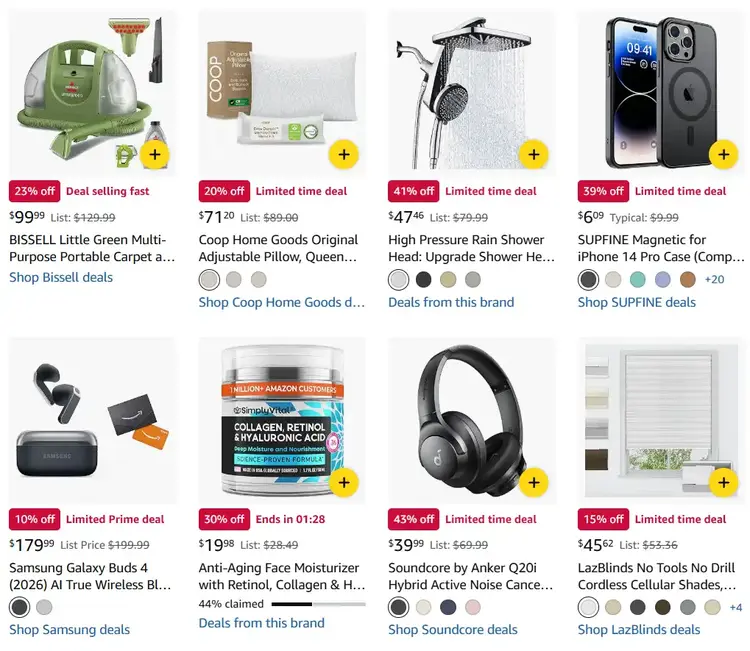
Most of these products are general consumer goods. Many of them are white label or private label products that can easily be sourced from platforms like Alibaba or other suppliers from China. Because of that, pricing is very transparent.
Low ticket products usually have low friction and are easy for users to purchase impulsively. However, when it comes to Google search ads, the problem is that keyword CPCs are generally quite high now. Since the commission per sale is very small, it is extremely difficult to cover the cost of clicks.
Because of this, I believe low ticket products are not suitable for Google search cold traffic. They are better suited for channels like SEO, Facebook Ads, or TikTok Ads.
2. High Ticket Products
In my definition, high ticket products are physical products priced above $300. The affiliate commission per sale should generally be higher than $50. If you want to run affiliate campaigns using Google search ads, I believe it is very difficult to cover the cost of clicks if the commission per sale is below $50.
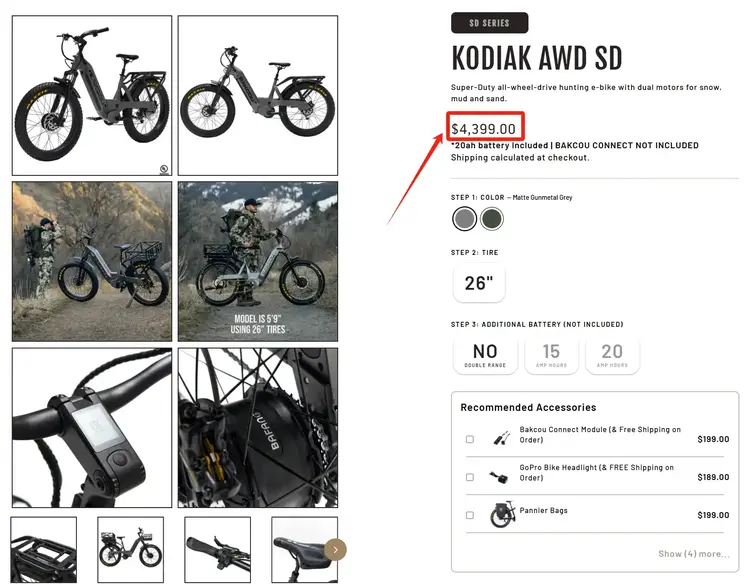
Compared with low ticket products, these products have a much longer buying decision cycle because the price is higher. Before making a purchase, users usually compare different options, read reviews, watch videos, and sometimes even ask for advice. In other words, the decision friction is higher.
On the other hand, the advantage is that the commission per sale is higher. One successful conversion can potentially cover a higher advertising cost, which theoretically makes these products more suitable for Google search cold traffic.
However, after evaluating everything, I personally feel that the conversion friction is still quite high. For someone like me who is testing Google Ads with a small budget, it may take a long time to collect enough data to determine whether the campaigns are profitable. At the same time, many high ticket product affiliate programs are not very friendly for beginners when applying.
Because of this, high ticket physical products are not the main direction for my current Google Ads testing.
3. One Time SaaS
In this article, when I refer to one time SaaS, I mean SaaS products that pay affiliate commissions only once, regardless of whether the pricing model is a one time payment or a monthly subscription. In other words, the affiliate commission is paid only one time instead of recurring.
When users search for these SaaS tools, it usually means they are actively looking for a solution to a specific problem. Because of that, the search keywords often have stronger conversion potential. In addition, many SaaS tools offer free trials or free versions, which lowers the friction.
The commission for this type of SaaS tool usually ranges from a few dollars to around $100, and sometimes higher. However, from an affiliate marketing perspective, the commission is generated only once, so the lifetime value of the user is limited.
At the same time, many high commercial intent keywords related to SaaS tools already have very high CPCs. Because of this, it can still be difficult to maintain a stable profit margin.
I believe this model can work under certain conditions, especially when you find keywords with lower CPC but strong commercial intent. However, from a long term profitability perspective, it may still be difficult to consistently cover high advertising costs. Because of that, it is not the most ideal model for Google search cold traffic.
4. Recurring SaaS
Recurring SaaS is very common in areas such as marketing automation tools, CRM software, and email marketing platforms. Similar to one time SaaS, users searching for these tools usually have strong intent because they are actively looking for solutions.
These SaaS products typically charge users on a monthly or yearly subscription basis. At the same time, many companies offer recurring affiliate commissions, usually ranging from 20 percent to 60 percent. As long as the user continues to subscribe, the affiliate marketer continues to receive commissions.
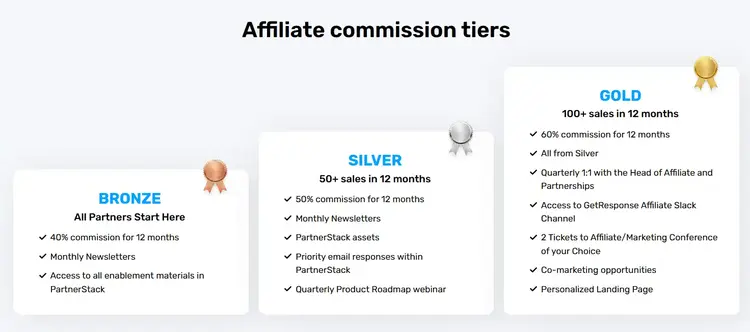
The biggest advantage of this model is the higher customer lifetime value. If the user keeps paying for the subscription, the affiliate marketer continues earning commissions over time, which helps cover the cost of paid traffic.
Another major advantage of SaaS compared to physical products is that many tools offer free trials or freemium versions. This can significantly reduce the friction for new users.
Because of these factors, recurring SaaS is often considered one of the most suitable affiliate models for Google Ads search cold traffic.
This is also the main direction I am focusing on in Experiment Iteration 3.
5. Lead Generation
Lead generation offers are affiliate offers where users only need to submit their information, such as filling out a form or registering for a trial. The affiliate marketer receives a commission without the user needing to make an immediate purchase.
This type of offer is common in industries such as finance, insurance, and education. Users usually only need to submit their information or complete a registration to generate a lead, so the friction is relatively low.
Because of that, lead generation can work well with Google search cold traffic. When users are looking for solutions, they are often willing to submit their information to receive a quote, consultation, or demo.
However, the commission for these offers is usually not very high, and the lifetime value is relatively low. In addition, some industries have strict compliance requirements. For example, finance and insurance are heavily regulated in Google Ads, and it can be difficult for new advertiser accounts to pass the review process.
Because of these factors, I personally think lead generation is also not the most suitable model for Google Ads search cold traffic.
6. Pay Per Call
Pay Per Call is a model where affiliates are paid based on phone call conversions. When a user calls the business and the call lasts for a certain amount of time, usually between 60 and 120 seconds, the affiliate marketer receives a commission.
This model is commonly used in local service industries such as home renovation, roofing repair, plumbing services, or solar installation. These services usually solve urgent problems, and many of the keywords have very strong search intent.
For example, a keyword like “emergency plumber near me” clearly shows that the user needs immediate help. Because of this, the friction is low and conversion rates can be quite high.
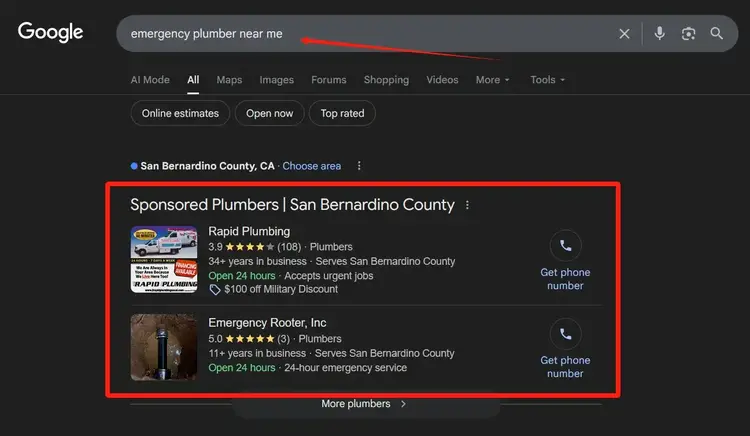
The commission for each qualified call varies depending on the industry, usually ranging from $20 to $150. Some industries like finance or insurance may pay more, but they also come with stricter compliance requirements.
For local service industries, I believe Pay Per Call can actually work well with Google search cold traffic. The key challenge is finding offers with sufficiently high payouts.
7. Digital Information Products
Digital information products include online courses, training programs, ebooks, and membership communities. These products are usually created by individual creators, coaches, or online education companies.
The pricing varies widely, but many affiliate offers are priced between $49 and $997. The commission rate is usually between 30 percent and 60 percent. Some online courses even offer recurring affiliate commissions.
However, the biggest challenge with this type of product is trust. Many users are naturally skeptical of online courses, especially when they come from cold traffic. Without strong brand recognition or personal authority, conversion rates can be relatively low.
Because of this, I believe digital information products are better promoted through content marketing, personal branding, or email lists rather than directly through Google search ads targeting cold traffic.
My Focus for the Next Experiment: Recurring SaaS Affiliate Offers
Because of all these factors, I decided to focus my future experiments on recurring commission SaaS affiliate offers, especially tools that offer free trials or freemium versions and have recurring affiliate programs.
My goal is to keep testing and eventually find a combination of keywords, offers, and ad strategies that can make Google Ads search traffic profitable for affiliate marketing.
How I Find Recurring SaaS Affiliate Offers
After determining that recurring SaaS affiliate offers are the best fit for Google search ads cold traffic, my next step for Experiment Iteration 3 was to find the most suitable recurring SaaS affiliate offers. Here are the main sources I currently use.
1. SaaS Marketplace Platforms
SaaS marketplace platforms are websites that showcase and distribute new or emerging SaaS products. Ex: Product Hunt, AppSumo, G2, and Capterra. These platforms help me discover tools, compare features, read reviews, and sometimes access affiliate programs offered directly by the SaaS companies.
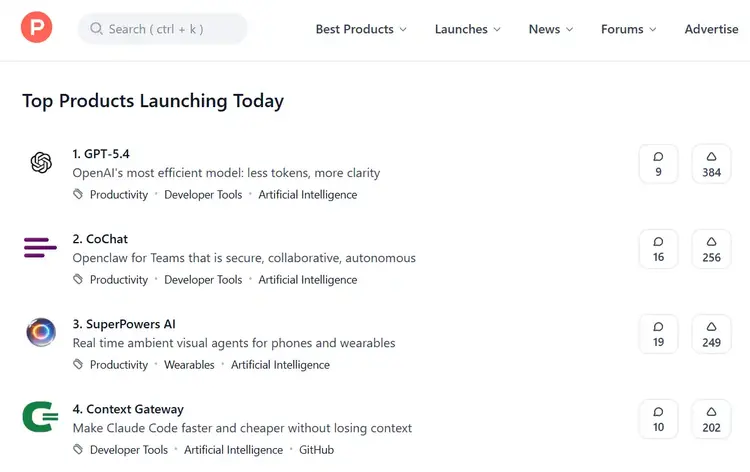
Since many of these products are still new, platforms like Product Hunt make it possible to discover early recurring SaaS affiliate programs. Compared to more established tools, they usually face less competition in Google search results for related keywords. This makes these platforms an ideal starting point for finding promising SaaS tools with potential recurring commissions before the market becomes saturated.
2. Affiliate Networks
Affiliate networks are platforms that connect marketers with products or services they can promote, for example, PartnerStack and Impact.
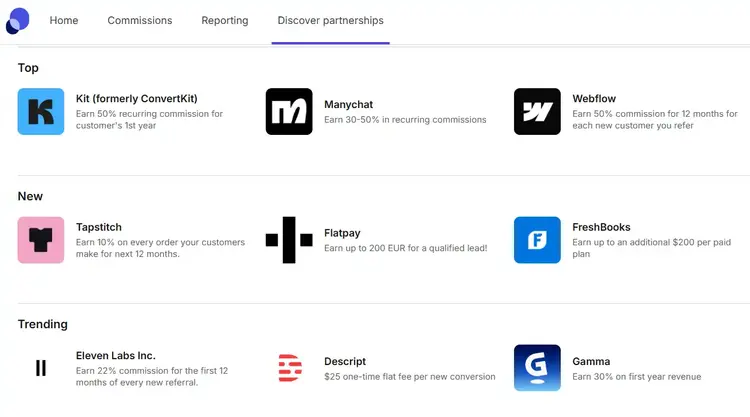
Because affiliate networks have marketplaces, they are well suited for affiliate marketers to browse and discover SaaS affiliate programs. They provide filters such as commission structure, cookie duration, payment models, and reporting tools, which makes it easier for me to choose the right products for my Google Ads campaigns.
As a beginner with no established traffic, I tested which SaaS affiliate networks are actually beginner-friendly to sign up for. What I found is that getting approved for programs on these platforms is honestly a lot harder than expected. They typically want you to lay out a clear marketing strategy and show that you already have an existing traffic source.
Also, affiliate networks usually have a two step approval process. The platform needs to approve your account first before you can apply to individual brand affiliate programs. So in reality, it can be a bit challenging for beginners.
3. Affiliate Marketing Software
Affiliate marketing software is used by SaaS companies to run and manage their own affiliate programs, such as Rewardful, Tapfiliate, and FirstPromoter. Unlike affiliate networks, these platforms do not act as intermediaries. They do not provide a marketplace, and each affiliate program is run independently by the company. This means that when I apply, I do not have to go through a two step approval process like I would with a network. I only need approval from the SaaS company itself.
Because of this, using affiliate software has been one of the best entry level ways for me to find recurring SaaS affiliate offers, especially at a stage when I do not yet have consistent traffic or a proven marketing strategy to show. I’ve been diving deep into how to hunt down SaaS affiliate programs by tracking affiliate software footprints. While the specific tactics vary slightly from one platform to another, the core logic remains pretty much the same. I’ve also used this approach to find some beginner-friendly recurring SaaS affiliate programs that you can get approved for without a website or any traffic proof.
4. SaaS Company Websites
Another option is to go directly to the SaaS company websites. Many companies run their own affiliate programs. To find them, you can search on Google using
[Tool Name] + affiliate program
[Tool Name] + partner program
Applying directly usually offers more flexibility in terms of commissions, promotional materials, and sometimes exclusive deals. Based on my experience, joining an affiliate program directly through the SaaS company website can even be easier than going through an affiliate network.
Summary
Based on my own analysis, recurring SaaS is the best affiliate offer type for cold traffic when running Google Ads search campaigns, at least for someone like me testing on a limited budget. Before I move on to Experiment Iteration 3, I need to research specific offers.
At the same time, through the process of writing this article and doing the research, I realized that my previous offer scoring tool had many shortcomings. I plan to revise and improve that tool moving forward.